WarpKriging::update
Description
Update a WarpKriging model with new observations.
Usage
Python
# wk = WarpKriging(...)
wk.update(y_u, X_u, refit = True)
R
# wk <- WarpKriging(...)
wk$update(y_u, X_u, refit = TRUE)
Matlab/Octave
% wk = WarpKriging(...)
wk.update(y_u, X_u, refit = true)
Julia
# wk = WarpKriging(...)
update(wk, y_u, X_u, refit=true)
Arguments
Argument |
Description |
|---|---|
|
Numeric vector of new response values. |
|
Numeric matrix of new input points. |
|
Logical. If |
Details
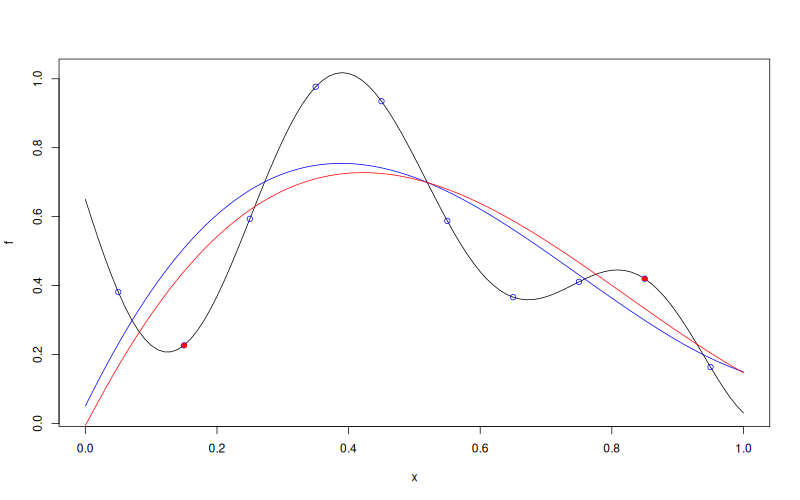
The new observations are appended to the training set in the original input space, then re-encoded through the fitted warping specification. Set refit = FALSE to reuse the current warp and GP hyper-parameters; set refit = TRUE to re-optimise them jointly.
Value
No return value. The WarpKriging object is modified in place.
Examples
f <- function(x) 1 - 1 / 2 * (sin(12 * x) / (1 + x) + 2 * cos(7 * x) * x^5 + 0.7)
X <- as.matrix(seq(0.05, 0.95, length.out = 10))
y <- f(X)

wk <- WarpKriging(
  y, X,
  warping = "kumaraswamy",
  kernel = "gauss",
  parameters = list(max_iter_adam = "20", max_iter_bfgs = "10")
)
plot(f)
points(X, y, col = "blue")

x <- as.matrix(seq(0, 1, length.out = 101))
p <- wk$predict(x, return_stdev = TRUE)
lines(x, p$mean, col = "blue")

X_u <- as.matrix(c(0.15, 0.85))
y_u <- f(X_u)
wk$update(y_u, X_u)
points(X_u, y_u, col = "red", pch = 16)

p_u <- wk$predict(x, return_stdev = TRUE)
lines(x, p_u$mean, col = "red")
Results