Usage
libKriging may be used through:
direct C++ access
Python wrapper
R wrapper
Octave wrapper
Matlab wrapper
Julia wrapper
The basic usage is almost the same across wrappers:
# input design
X = ...
# output results
y = ...

# load / import libKriging
...
# build & fit a model
k = Kriging(y, X, kernel="gauss", noise=None)
# display model
print(k)

# setup another (dense) input sample
x = ...

# predict at x
p = k.predict(x, return_stdev=True)

# and/or simulate at x
s = k.simulate(nsim=10, seed=123, x=x)
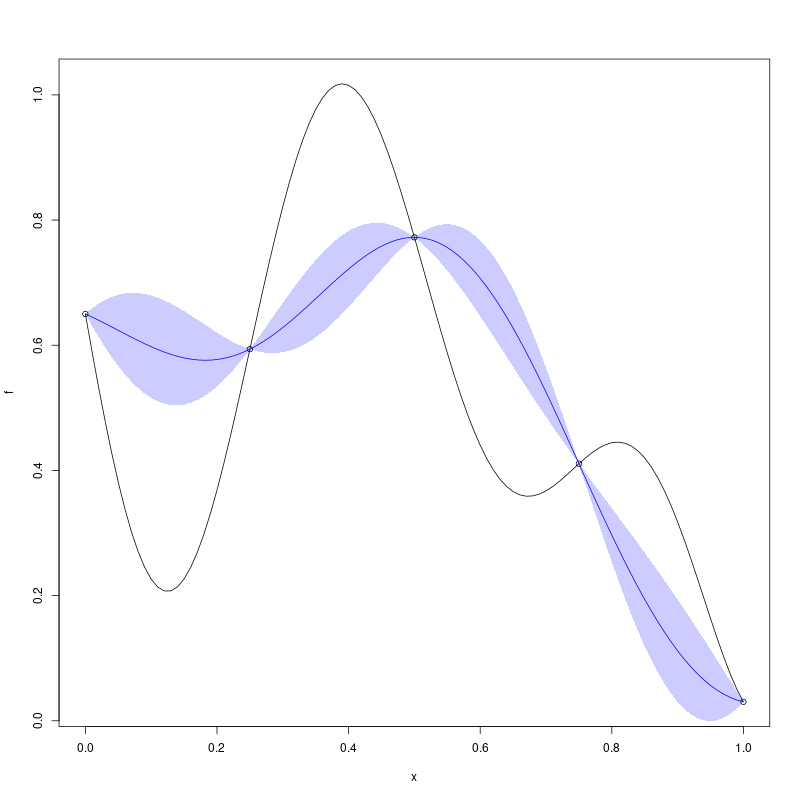
Basic demo
Sample the objective function
at \(X = \{0.0, 0.25, 0.5, 0.75, 1.0\}\), then predict and simulate in \([0,1]\).
This code, for Python, R, Matlab/Octave or Julia should return for both Python:  , R: or Matlab/Octave :

Large designs
For designs too large for an \(O(n^3)\) exact fit, libKriging offers two complementary tools:
NestedKriging— divide-and-conquer GP: the data are split into groups, one submodel is fitted per group with a common prior, and predictions are aggregated (optimalNK, orPoE/gPoE/BCM/rBCM). Robust in any input dimension.nk = lk.NestedKriging(y, X, "matern5_2", 100, aggregation="NK") mean, stdev = nk.predict(Xt, True)
objective="VLL(m)"— fit a plainKrigingwith the Vecchia approximated log-likelihood (\(O(n\,m^3)\) per evaluation). Best for low-to-moderate input dimension (\(d \lesssim 5\)).k = lk.Kriging(y, X, "matern5_2", objective="VLL(30)")
SciKit-Learn wrapping
Implement a SciKit-Learn BaseEstimator around the unified v1.0.0 API:
from sklearn.base import BaseEstimator
import pylibkriging as lk
import numpy as np

class KrigingEstimator(BaseEstimator):
  def __init__(self, kernel="matern3_2", regmodel="constant", normalize=False,
               optim="BFGS", objective="LL", noise=None, parameters=None):
    self.kernel = kernel
    self.regmodel = regmodel
    self.normalize = normalize
    self.optim = optim
    self.objective = objective
    self.noise = noise
    self.parameters = parameters or {}
    self.kriging = lk.Kriging(self.kernel)

  def fit(self, X, y):
    noise = None
    if self.noise == "nugget":
      noise = "nugget"
    elif self.noise is not None:
      noise = np.repeat(float(self.noise), len(y))
    self.kriging.fit(y, X, self.regmodel, self.normalize, self.optim,
                     self.objective, self.parameters, noise)
    return self

  def predict(self, X, return_std=False, return_cov=False):
    pred = self.kriging.predict(X, return_std, return_cov, False)
    if return_cov:
      return pred["mean"], pred["cov"]
    if return_std:
      return pred["mean"], pred["stdev"]
    return pred["mean"]

  def sample_y(self, X, n_samples=1, random_state=0):
    return self.kriging.simulate(nsim=n_samples, seed=random_state, x=X)

  def log_marginal_likelihood(self, theta=None, eval_gradient=False):
    if theta is None:
      return self.kriging.logLikelihood()
    return self.kriging.logLikelihoodFun(theta, eval_gradient, False)
More examples
1D demo:
2D demo: