MLPKriging
Description
Create an MLPKriging object for Deep Kernel Learning: a joint multi-layer
perceptron (MLP) is applied to all inputs before the GP kernel is evaluated.
All MLP weights, GP range parameters, variance and trend coefficients are jointly optimised by maximising the concentrated log-likelihood.
Usage
Just build the model:
Python
mk = MLPKriging(hidden_dims=[32, 16], d_out=2, kernel="gauss")
# later, call mk.fit(y, X, ...)
R
mk <- MLPKriging(hidden_dims = c(32L, 16L), d_out = 2L, kernel = "gauss")
# later, call mk$fit(y, X, ...)
Matlab/Octave
mk = MLPKriging(hidden_dims = [32, 16], d_out = 2, kernel = "gauss");
% later, call mk.fit(y, X, ...)
Julia
mk = MLPKriging(hidden_dims=[32, 16], d_out=2, kernel="gauss")
# later, call fit(mk, y, X, ...)
or build and fit at the same time:
Python
mk = MLPKriging(y, X, hidden_dims=[32, 16], d_out=2, activation="selu",
                kernel="gauss", regmodel="constant", normalize=False,
                optim="BFGS+Adam", objective="LL", parameters=None)
R
mk <- MLPKriging(y, X, hidden_dims = c(32L, 16L), d_out = 2L, activation = "selu",
                 kernel = "gauss", regmodel = "constant", normalize = FALSE,
                 optim = "BFGS+Adam", objective = "LL", parameters = NULL)
Matlab/Octave
mk = MLPKriging(y, X, hidden_dims = [32, 16], d_out = 2, activation = "selu", ...
                kernel = "gauss", regmodel = "constant", normalize = false, ...
                optim = "BFGS+Adam", objective = "LL", parameters = [])
Julia
mk = MLPKriging(y, X, hidden_dims=[32, 16], d_out=2, activation="selu",
                kernel="gauss", regmodel="constant", normalize=false,
                optim="BFGS+Adam", objective="LL", parameters=nothing)
Arguments
Argument |
Description |
|---|---|
|
Numeric vector of response values. |
|
Numeric matrix of input design. |
|
Integer vector of hidden layer widths, e.g. |
|
Output feature dimensionality (dimension of \(\Phi\)). Default |
|
Activation function for hidden layers: |
|
Base covariance kernel in feature space: |
|
Universal Kriging linear trend in feature space: |
|
Logical. If |
|
Optimiser. |
|
Objective function. Currently |
|
Optional named list / dict for tuning: |
Details
The MLP feature extractor \(\Phi : \mathbb{R}^d \to \mathbb{R}^{d_{\text{out}}}\) shares
weights across all inputs (cross-variable interactions). This contrasts with
WarpKriging, where each input is mapped independently.
The default "BFGS+Adam" optimiser alternates between:
Adam outer loop — updates MLP weights with gradient descent.
L-BFGS-B inner loop — optimises \(\log\theta\) with exact gradients.
\(\hat\sigma^2\) and \(\hat\beta\) are concentrated out analytically at every step.
Value
An object of class "MLPKriging". Use with its predict, simulate, update methods.
Examples
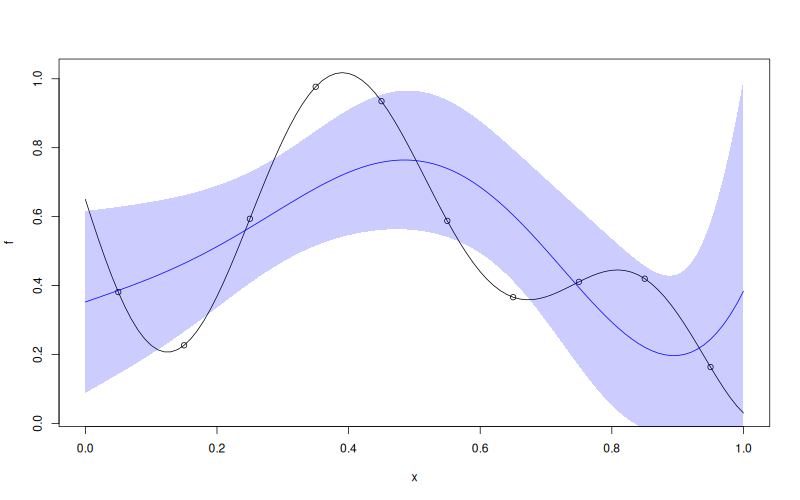
f <- function(x) 1 - 1 / 2 * (sin(12 * x) / (1 + x) + 2 * cos(7 * x) * x^5 + 0.7)
X <- as.matrix(seq(0.05, 0.95, length.out = 10))
y <- f(X)

mk <- MLPKriging(
  y, X,
  hidden_dims = c(4L),
  d_out = 1L,
  activation = "tanh",
  kernel = "gauss",
  parameters = list(max_iter_adam = "20", max_iter_bfgs = "10")
)
print(mk)

x <- as.matrix(seq(0, 1, length.out = 101))
p <- mk$predict(x, return_stdev = TRUE)
plot(f)
points(X, y)
lines(x, p$mean, col = "blue")
polygon(c(x, rev(x)), c(p$mean - 2 * p$stdev, rev(p$mean + 2 * p$stdev)),
        border = NA, col = rgb(0, 0, 1, 0.2))
Results
* MLPKriging
* data: 10x[0.05,0.95] -> 10x[0.163421,0.976851]
* trend constant (est.): -745.4
* variance (est.): 3.13668e+08
* covariance:
  * kernel: gauss
  * range (est.): 2.88992
  * warpings:
      joint: "mlp_joint(4,1,tanh)"  →  MLPJoint(1 -> 4 -> 1, 13 params)
  * total warp params: 13
  * fit:
    * objective: LL
    * optim: BFGS+Adam