WarpKriging::simulate
Description
Simulate from a WarpKriging Model Object.
Usage
Python
# wk = WarpKriging(...)
wk.simulate(nsim = 1, seed = 123, x)
R
# wk <- WarpKriging(...)
wk$simulate(nsim = 1, seed = 123, x)
Matlab/Octave
% wk = WarpKriging(...)
wk.simulate(nsim = 1, seed = 123, x)
Julia
# wk = WarpKriging(...)
s = simulate(wk, nsim=1, seed=123, x)
Arguments
Argument |
Description |
|---|---|
|
Number of simulations to draw. |
|
Random seed used. |
|
Points in model input space (original, un-warped) where to simulate. |
|
Logical. Set to |
Details
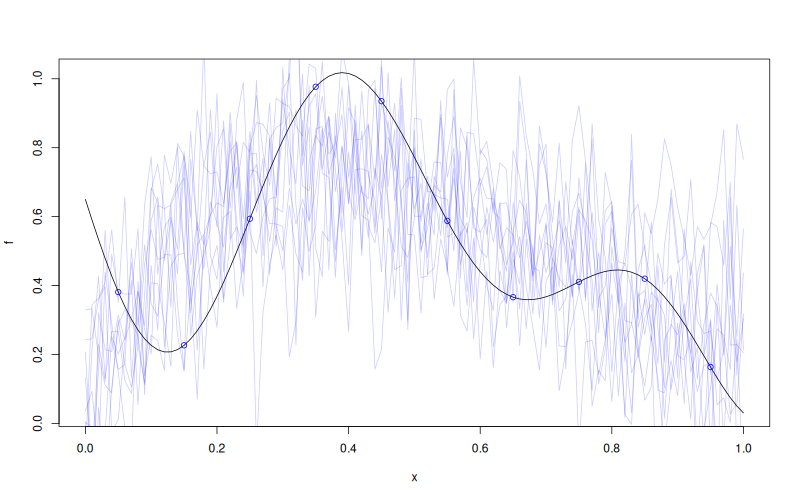
Draws \(n_{\texttt{sim}}\) conditional paths of the GP at the new input points, using the posterior covariance computed in the warped feature space \(\Phi(\mathbf{x})\).
Value
A matrix with nrow(x) rows and nsim columns containing the simulated
paths at the input points given in x.
Examples
f <- function(x) 1 - 1 / 2 * (sin(12 * x) / (1 + x) + 2 * cos(7 * x) * x^5 + 0.7)
X <- as.matrix(seq(0.05, 0.95, length.out = 10))
y <- f(X)

wk <- WarpKriging(
  y, X,
  warping = "kumaraswamy",
  kernel = "gauss",
  parameters = list(max_iter_adam = "20", max_iter_bfgs = "10")
)
x <- as.matrix(seq(0, 1, length.out = 101))
s <- wk$simulate(nsim = 10, seed = 123, x = x)

plot(f)
points(X, y, col = "blue")
matlines(x, s, col = rgb(0, 0, 1, 0.2), type = "l", lty = 1)
Results