ordinal — Ordinal warping
Description
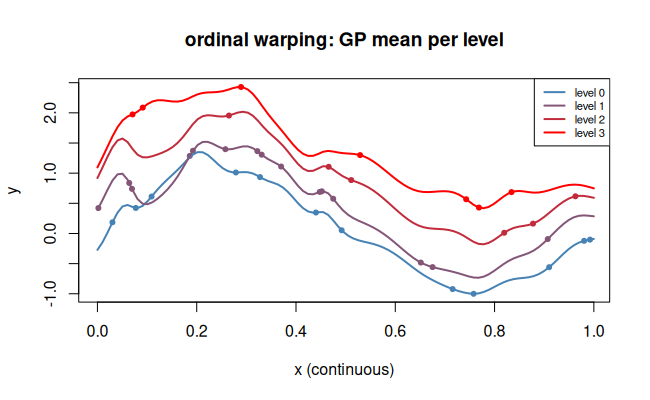
Maps an ordinal variable with \(L\) levels (\(0,1,\ldots,L-1\)) to a scalar through a set of \(L-1\) learned, ordered positions on the real line:
Unlike categorical, the ordering constraint is enforced, which reduces
the number of free parameters and improves generalisation.
Specification
warp_ordinal(n_levels = 4)
# returns e.g. "ordinal(4)"
Parameters
Argument |
Role |
|---|---|
|
number of ordered levels \(L\) |
Regression example
library(rlibkriging)

set.seed(20)
n_levels <- 4
n        <- 40

# Continuous + ordinal input
X_cont <- runif(n)
X_ord  <- sample(0:(n_levels-1), n, replace = TRUE)
X      <- cbind(X_cont, X_ord)

# Response increases with ordinal level
level_val <- c(0, 0.4, 0.9, 1.5)
y <- sin(2 * pi * X_cont) + level_val[X_ord + 1] + 0.05 * rnorm(n)

wk <- WarpKriging(
  y, X,
  warping = c(warp_kumaraswamy(), warp_ordinal(n_levels)),
  kernel  = "matern5_2",
  optim   = "BFGS+Adam"
)

x_seq <- seq(0, 1, length.out = 100)
cols  <- colorRampPalette(c("steelblue","red"))(n_levels)
plot(X_cont, y, col = cols[X_ord + 1], pch = 19, cex = 0.7,
     xlab = "x (continuous)", ylab = "y",
     main = "ordinal warping: GP mean per level")
for (lev in 0:(n_levels-1)) {
  X_pred <- cbind(x_seq, lev)
  p <- wk$predict(X_pred, return_stdev = FALSE)
  lines(x_seq, p$mean, col = cols[lev + 1], lwd = 2)
}
legend("topright", paste("level", 0:(n_levels-1)),
       col = cols, lwd = 2, cex = 0.7)
Comparison with categorical
Property |
|
|
|---|---|---|
Ordering constraint |
✔ enforced |
✘ ignored |
Free parameters |
\(L-1\) |
\(L \times q\) |
Suitable when |
levels have a natural order |
levels are unordered |
References
Saves, P., Lafage, R., Bartoli, N., Diouane, Y., Bussemaker, J., Lefebvre, T., Hwang, J. T., Morlier, J., & Martins, J. R. R. A. (2024). SMT 2.0: A Surrogate Modeling Toolbox with a Focus on Hierarchical and Mixed Variables Gaussian Processes. Advances in Engineering Software, 188, 103571. DOI: 10.1016/j.advengsoft.2023.103571 · arXiv: 2305.13998
Qian, P. Z. G., Wu, H., & Wu, C. F. J. (2008). Gaussian Process Models for Computer Experiments with Qualitative and Quantitative Factors. Technometrics, 50(3), 383–396. DOI: 10.1198/004017008000000262